
WEAVE - WEEK 8 RISK IS SHARED, NOT OUTSOURCED
Risk Is Shared, Not Outsourced
4/11/20265 min read
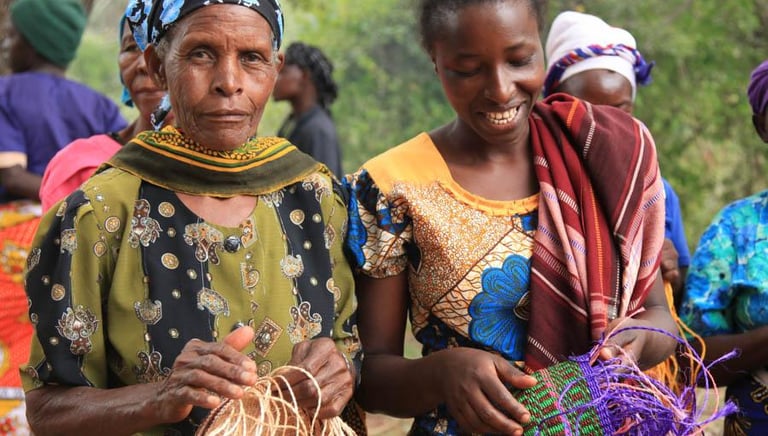
WEAVE WEEK 8 Risk Is Shared, Not Outsourced
W — WORK
Risk Is Shared, Not Outsourced
The first order was small enough to feel manageable and large enough to matter.
We approached it as one might expect. There were conversations about quantities, about timelines, about what constituted a finished piece. Measurements were clarified. Details repeated. And then, as a matter of routine, we prepared to send a deposit.
It seemed obvious.
The deposit would secure the order. It would signal commitment. It would, in a quiet way, transfer a portion of the risk from us to the production system.
But the money was not taken.
The weaving group politely, almost casually, declined it. They would proceed, they said, and deliver once the work was complete.
There was no contract. No formal agreement beyond the exchange itself. No mechanism through which the work could be enforced.
And yet, the order arrived.
In more formalised production systems, risk is rarely allowed to sit still.
It is broken apart, assigned, and managed. Contracts specify responsibility. Deposits secure compliance. Quality control intervenes before failure can travel too far downstream. Each stage absorbs a portion of uncertainty until what remains is small enough to be tolerated.
Risk, in this sense, is something to be moved.
Preferably away from the centre.
What we encountered instead was a system in which risk was not transferred, but held.
Not visibly. Not through documentation or process, but through something more diffuse.
Reputation.
Not the outward-facing kind, but the internal one. The kind that circulates within a group, accumulates over time, and carries consequences without needing to declare itself.
Delivering poorly is not simply failing an order. It is to alter one’s position within the system. To delay without cause is to introduce friction that others must absorb. To withdraw is to step outside a network that depends, quietly, on continuity.
The system does not eliminate risk.
It distributes it differently.
This distribution is uneven and not always stable.
Work moves through multiple hands, across distances that are not easily coordinated. Time expands and contracts. Materials behave in ways that resist standardisation. There are moments when the system appears to loosen, when outcomes feel less certain.
But the response is not to isolate responsibility.
It is to absorb the variation collectively.
At PAM YO!, this required a shift in how we understood our own position.
It is easy, at the outset, to assume that introducing capital brings control. That payment secures outcome. That risk, once priced, can be contained.
But capital does not remove risk.
It rearranges it.
And in doing so, it can unsettle the system it enters.
An advance payment, intended as support, can alter the pacing of work. A fixed deadline can compress a rhythm that was previously elastic. A detailed specification can override forms of quality control that are not written down, but widely understood.
What appears, from one side, as structure, may be experienced, from another, as pressure.
The question, then, is not how to eliminate risk.
It is how to recognise where it already sits.
And how to enter the system without displacing it entirely onto one side.
This is less a technical adjustment than a positional one.
It requires resisting the instinct to secure everything in advance. To allow some uncertainty to remain where it is already held. To recognise that not all risk needs to be absorbed centrally in order for the system to function.
In some cases, doing so weakens it.
The order, when it arrived, was complete.
Not identical, but coherent. Not standardised, but recognisable.
It carried, within it, the conditions of its making.
And with it, the quiet evidence of a system that had held its own risk—without needing to move it elsewhere.
Claim
Risk is not something to be removed from the system.
It is something to be understood—and shared without being displaced.
E — EYE
The Return of The Faraway Tree
This week, it was The Magic Faraway Tree—or rather, its return to the cinema.
I wasn’t looking for it. It appeared.
A familiar title, resurfacing in a different form.
It took me back, not just to the story, but to the way it was told.
Enid Blyton wrote at a scale that is difficult to grasp now. Not just in volume, but in range. Entire worlds, built across books, animals, forests, small domestic details, all rendered in a way that made them feel immediate.
For me, she explained England before I had ever been there.
Not as mere information, but as an environment. I used to walk the countryside expecting to be welcomed by some friendly farmer’s wife offering a lash of ginger beer and the best cakes and tarts.
What strikes me now is how child-centred it was.
Not simplified. Not softened. But structured around a child’s way of encountering the world, through curiosity, repetition, small discoveries.
There was no need to declare importance.
Attention did the work.
We have other ways of seeing now.
David Attenborough shows us the natural world with precision, scale, and authority. It is expansive, and often extraordinary.
But it is not the same.
It is not built around the child’s position within the world, but around the world itself. It portrays its systems, its survival and its spectacle.
And somewhere along the way, the tone shifts.
The lion chases the antelope.
The stakes become visible.
And the day, for a child, comes to an end.
What Blyton offered was different.
A world held at a scale that could be entered without threat.
A system of attention that stayed with the small, the near, the familiar.
Seeing The Faraway Tree return now raises a quiet question.
Not about adaptation, or nostalgia.
But about how we introduce the world.
A — ARCHIVE
This week: Explore the Collection
This is a digital prototype catalogue of the Dresses of the Year archive.
More than five hundred pieces, Mary Quant, Alexander McQueen, Vivienne Westwood, Ossie Clark. These are made accessible through a system that prioritises navigation as much as preservation.
What matters here is not the archive itself, but the interface.
The collection has been restructured through user testing, image clarity, and digital pathways that allow movement across time, material, and form. It is less about viewing a fixed canon and more about how one moves through it.
Why now?
Because access is no longer the barrier. Interpretation is.
As more collections become digitally available, the question shifts from what is held to how it is encountered.
The archive is no longer static. It behaves.
And in that shift, curation begins to look less like storage, and more like system design.
V — Voice
Marketing Without a System
I am working within a constraint I don’t fully understand yet.
There are tools everywhere. We have platforms, schedulers, AI systems. Some of them I use well. I can generate images. I can write, structure, and publish. That part moves.
But the system around it does not hold.
Notion, for example, promises order. I can see what it could become, a command centre, a place where everything connects. But in practice, it remains just out of reach. Too many moving parts. Too little coherence.
And then there is distance.
Different levels of access. Different speeds of connection. Different relationships to the tools themselves. What feels immediate in one place becomes slow, or fragmented, in another.
So the work is uneven.
Not because the ideas are unclear, but because the system that should hold them is still forming.
Constraint:
How do you build a coherent system when the tools, and the contexts do not align?
E — Echo
At what point does trying to manage risk begin to weaken the system that already knows how to hold it?