
WEAVE - WEEK 7 DESIGN ADAPTS TO SYSTEMS
An ongoing series on material systems, labour, and design.
4/8/20265 min read
WEAVE WEEK 07 DESIGN ADAPTS TO SYSTEMS
This essay is part of WEAVE, a weekly series on material systems, labour, and design.
Read more at PAM YO studio
An ongoing series on material systems, labour, and design.
W — WORK
The first basket did not arrive as expected.
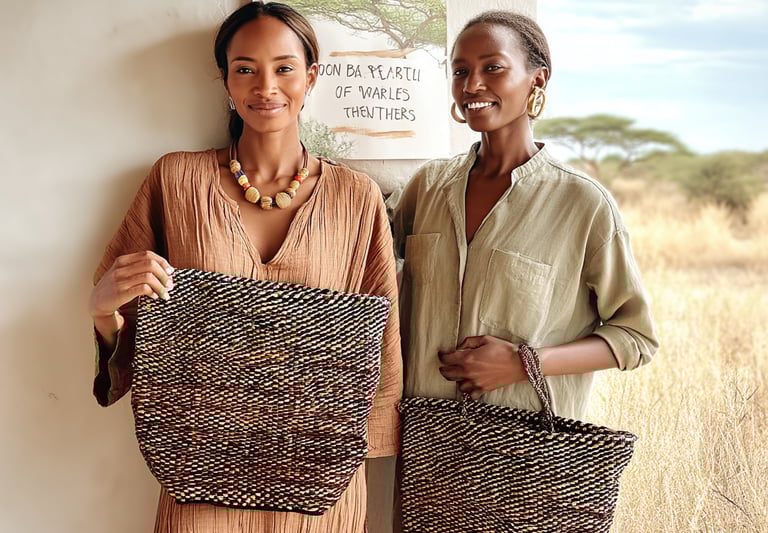
It held its shape, more or less. The proportions were close enough to recognise the intention. But the handle sat slightly off-centre, the weave tightened in one corner and loosened in another, as if the object had adjusted itself mid-construction. It was not wrong, exactly. It simply did not conform.
In most design contexts, this would be treated as an error.
The brief would be revisited. The deviation corrected. A system, production schedules, quality checks, standard measurements, would be put in place to ensure that the next basket, and the one after that, behaved identically. Design, in this sense, is understood as the imposition of order: a way of bringing variation under control.
But the baskets did not begin there.
They emerged from a system that was already in motion, distributed across homes and compounds, shaped by routines that had little to do with production targets. Weaving happened between other things: in the late afternoon, after cooking; in the pauses of the day; in rhythms that resisted consolidation. Skill was not absent, but it was not standardised. Time was not measured in units. Coordination existed, but loosely.
To approach such a system with the expectation of control is to misunderstand it.
What appears, at first, as inconsistency begins to read differently with attention. The variation is not random. It follows the logic of material, of hand, of sequence. A tighter weave here compensates for a softer fibre. A shift in proportion reflects a decision made in the moment, not an oversight. The object records the conditions of its making.
Design, in this context, does not eliminate these conditions. It encounters them.
And where it insists, on exact measurements, on uniform tension, on fixed timelines, it meets resistance. Not because the system is inefficient, but because it is organised differently. The constraints are not technical problems waiting to be solved. They are structural realities: distance, coordination, embodied knowledge, the behaviour of natural fibre.
There is another way to proceed.
Rather than beginning with the brief as a fixed point, design can begin with the system itself. It can observe before it specifies. It can interpret before it corrects. It can ask what the system already does well, and where it might stretch.
At PAM YO!, this has meant working less like a director and more like a translator.
Measurements are introduced, but negotiated.
Timelines are suggested, but adjusted.
Techniques are refined, but through repetition rather than instruction.
The system responds. Slowly, and not always predictably. But it does respond.
Handles begin to align more consistently. Proportions stabilise. Variations remain, but within a narrower range. What emerges is not standardisation in the industrial sense, but a form of coherence—recognisable, repeatable, and still grounded in the conditions of its making.
The baskets do not become identical.
They become legible.
This distinction matters.
In much of design theory, systems are treated as something to be built, frameworks that enable the execution of an idea. Here, the system precedes the design. It is not a constraint to be overcome, but a structure to be understood.
The tension, then, is not between good and bad design, nor between modern and traditional forms. It is between two assumptions: that order must be imposed, or that it can be found.
The difference is subtle, but consequential.
To impose order is to risk flattening the system—to replace its internal logic with an external one. To recognise order is to work with what is already there, extending it without erasing it.
This requires a shift in position.
Not: How do we make the system fit the design?
But: What does the system make possible—and how far can it stretch?
In this sense, design becomes less about control and more about attention. Less about execution and more about interpretation.
The work is not to create order.
It is to notice it, and to build from there.
Claim
Design does not create order.
It reveals and extends the order that is already there.
E — Eye
THE COLOUR BROWN
The eye sees what the eye sees. And what the eye has seen, it cannot unsee.
— Linda Odhiambo, 2026
This week, it was brown.
Not abstractly. Not on a moodboard.
In objects. Everywhere.
Years ago, my friend Jon, of Java Kenya, showed me the walls of a new venture, Ankole Grill. A deep, complex brown. Almost grey. He took time to describe it, circling the colour in sentences before landing on it. That stayed with me.
I saw brown clearly that evening.
Then, for a long time, I didn’t.
I have a complicated relationship with it.
I am brown. I love brown, on people, it is us.
But growing up in rural Kenya, brown was the colour of non-design.
Of dirt. Of something to be washed away.
That tension doesn’t disappear. It lingers.
And yet, over the past few years, brown has returned.
Mid-brown suede. Deep chocolate leather. Variations everywhere. I have always been a fan of mid-brown suede, and I own several suede skirts, jackets and shirts. You know the proud moment when fashion catches up with one, which is laughable because maybe it’s because I was out of fashion for the longest time. It’s a winter thing for me. But with the current trend, even I have found myself buying into it, all sorts of rich, deep browns, quietly negotiating where the material ends and my skin begins.
But this week, it wasn’t fashion I noticed. It was objects.
Leather handles darkened through use.
Polished wood catching low light.
Sisal fibres sitting between sand and soil.
Even burgundy, often treated separately, holds brown within it.
Brown does not announce itself.
It absorbs. It settles.
Which is why its return is striking.
Not long ago, colour moved in the opposite direction, pink quartz, yellow, baby blue, high clarity, high visibility. Colours that signal quickly. That photograph well. That travel fast.
Brown resists that.
It requires time. It shifts with light, with wear, with touch. It is less about appearance and more about presence.
Its re-emergence is not just aesthetic.
It suggests a change in what we are willing to look at and how long we are willing to stay with it.
Not everything needs to be seen immediately.
Brown doesn’t demand attention—it rewards it.
A — Archive – THE RESIDENCE
This week: The Residence.
A rare case of staying past the ten-minute test. Most things don’t survive it. This did.
On the surface, it is a whodunnit set in the White House. Familiar territory. But what holds it together is the detective. A Black woman whose method is built around birdwatching. Not as a quirk, but as a system.
She observes.
She classifies.
She waits.
Somewhere between Inspector Clouseau, Benoit Blanc, Hercule Poirot and Miss Marple, but without imitation. It doesn’t lean on stereotype, and more importantly, it doesn’t collapse into neatness the way many adaptations do.
What’s useful here, in relation to WEAVE, is the method.
She doesn’t impose a theory onto the case.
She reads the environment.
Bird traits become a way of understanding behaviour. Patterns emerge not from forcing order, but from recognising what is already there.
It’s the same shift:
Not control, but attention.
Not imposition, but interpretation.
The case resolves because the system is understood.
If you haven’t watched it, it’s worth your time. Not for the plot alone, but for how it thinks.
V — Voice
Premature Capitalism
I keep seeing this pattern.
The language of business arrives before the system can hold it.
Pricing without costing.
Competition without differentiation.
Speed without coordination.
Artisans start undercutting each other. This is not because the work has changed, but because the pressure has.
It looks like market behaviour.
It isn’t.
It’s strain.
State systems try to stabilise it.
Global markets try to scale it.
Neither really fits.
So the system stretches in all directions.
I don’t think the problem is capitalism itself.
I think it’s timing.
E — Echo
At what point does introducing market logic begin to damage the system rather than strengthen it?