
WEAVE - WEEK 6 REPUTATION AS GOVERNANCE
In distributed production systems, reputation replaces supervision as the primary mechanism of governance.
3/23/20263 min read

WEEK 6
Reputation as Governance
W — Work
In distributed production systems, reputation replaces supervision as the primary mechanism of governance.
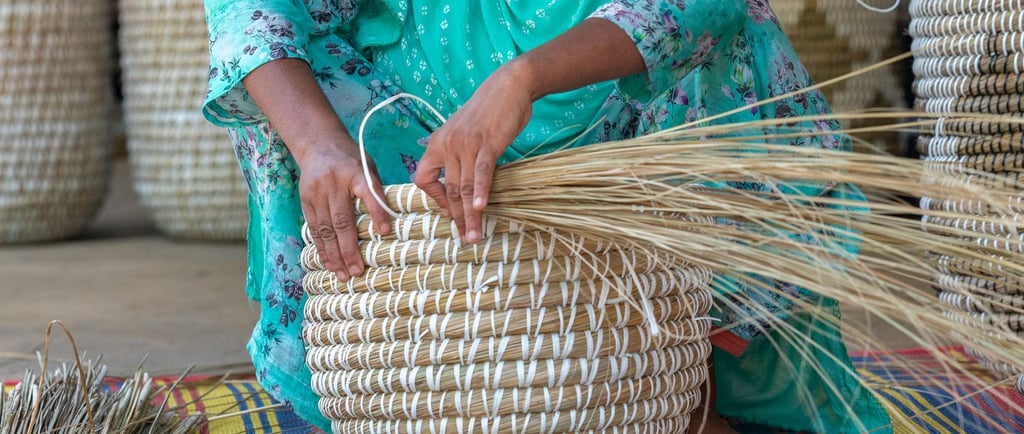
We began working with Ana Mueni and her group without imposing a production system.
At the time, they were producing standard tourist-market bags. They were functional, but not aligned with what we needed. From the outset, we chose to develop new forms: new sizes, new proportions, working within traditional weaving techniques but pushing toward precise specifications.
The first samples were difficult. Measurements, handle drops, and structural consistency required adjustment. But the group persisted. Over time, they achieved accuracy.
When we moved to production, something unexpected happened.
They refused a deposit.
They took full responsibility for delivery, quality, specification, and timing.
No one was supervising their work.
No inspection system was in place.
Yet the order arrived complete, consistent, and correct.
The Problem
Industrial production assumes output requires control.
Supervision monitors labour.
Inspection verifies quality.
Enforcement ensures compliance.
Remove these, and the system is expected to fail.
Therefore, by that logic, this production should not have worked.
But it did.
The Shift
What operated instead was a different system: Reputation as governance.
Work is not controlled externally; instead, it is regulated internally, through shared knowledge and visible performance.
Each maker knows:
· her own capability
· the capability of others
· the standard expected
· and the consequence of failing to meet it
The fact that future work depends on present delivery drives reliability and the accumulation of this over time. This becomes visible to the group, ensuring group survival. Monitoring is not removed; instead, it is distributed.
Mechanisms
This system functions through three mechanisms.
1. Repeated relationships
Work is not transactional. It is ongoing.
Future inclusion depends on current performance.
2. Network visibility
Performance is observed socially, not formally.
Everyone knows who delivers, who delays, and who compromises quality.
3. Consequence through inclusion
There is no formal punishment system.
Instead, Reliable makers are included in future orders while unreliable makers are excluded.
The unit of production is the group.
Responsibility is shared, but accountability is specific.
Implication
This challenges a core assumption: that informal systems are ungoverned. They are simply governed differently. This method of governing is effective.
The risk with this is not a lack of control. Instead, the risk is imposing the wrong kind of control. Introducing external supervision into this system would not stabilise it; it would disrupt it. Because it would override the mechanisms that already ensure performance.
Reputation is not soft.
It is enforcement without a centralised infrastructure.
E — Eye
Maasai Beadwork: Material, Movement, and Ownership
I encountered beaded coasters in an anthropology shop, objects that redirected attention to material and origin. What are often called “Maasai beads” are, in fact, largely Czech glass seed beads: traded materials that have been absorbed into East African making traditions. Historically, beadwork signified age, marital status, and social position, with women as primary makers.
Today, these beads enable intricate, consistent patterning, though lower-cost plastic alternatives are increasingly present. Beyond jewellery, beadwork has extended into belts, collars, and domestic objects, products shaped as much by market demand as by tradition.
The circulation of materials complicates common ideas of authenticity. What is considered “traditional” is often already the result of adaptation and exchange. The beads are not local in origin, but the systems of meaning, pattern, and use are. This distinction matters when evaluating ownership and authorship in contemporary design.
The question is no longer where the beads come from, but who gets to define what they become.
A — ARCHIVE
Hand-Drawn Authenticity — Signal and Shift
Several established brands, including Hermès, TSB Bank, and Great Western Railway, have reintroduced hand-drawn or hand-rendered visual elements into their brand systems. This marks a shift from purely digital precision toward controlled imperfection
Hand-drawn graphics introduce variation in line, weight, and form—qualities absent in fully digital outputs. These characteristics signal authorship, craft, and human involvement.
This move often appears alongside increased use of tactile materials such as wool, raffia, and paper-based textures. Together, they reposition brands within a landscape increasingly defined by automation and standardisation.
The effect is not nostalgic.
It is strategic differentiation.
V — Voice
Local Production vs Mass Production
We prioritise local production because provenance matters. It anchors the product in place, labour, and story.
But the economics are not neutral.
When developing packaging, dust bags, labels, branded elements. The the intention is to produce locally, with the same integrity as the basket itself. In practice, this is difficult. Small-scale local production struggles to meet price, consistency, and volume requirements.
The result is a constant tension: maintain provenance, or optimise cost.
Mass production offers efficiency and uniformity.
Local production offers meaning and traceability.
The decision is not ideological.
It is structural.
Every product sits somewhere along this line.
E — Echo
Who gets to define authenticity in a system shaped by both local making and global materials?