
WEAVE — WEEK 5 THE QUIET INTELLIGENCE OF CRAFT: ON MAGDALENE ODUNDO AND JONATHAN ANDERSON,
THE QUIET INTELLIGENCE OF CRAFT: ON MAGDALENE ODUNDO AND JONATHAN ANDERSON
3/17/20265 min read

WEAVE — Week 5
THE QUIET INTELLIGENCE OF CRAFT:
ON MAGDALENE ODUNDO AND JONATHAN ANDERSON
W — WORK
En Marwa — She Is Ours
I couldn’t stop thinking about it after watching the Dior show.
It was not just the silhouettes.
And it was not just the setting or the spectacle of Paris.
But the thread running quietly underneath it all: craft.
Jonathan Anderson
Jonathan Anderson has built a reputation for pulling fashion toward the language of making. Until he arrived at Loewe, I did not know much about the house. Then I read an interview in which he spoke about his fascination with craft and the people who carry it.
That resonated with me.
Throughout his work, Anderson has consistently drawn inspiration from artists and artisans rather than from fashion’s usual cycle of seasonal references.
He collaborates with people who understand materials.
Ceramicists.
Artists.
Jewellers.
Basket makers.
Leather workers.
Furniture designers.
Stone masons.
Architects.
In his collections, you see it clearly: leather treated like sculpture, raffia behaving like structure, woven trunks that feel less like luggage and more like architectural objects.
Watching the show this week, I noticed something I could never have imagined before.
The forms reminded me of someone else.
Magdalene Odundo.
Magdalene Odundo; Living Clay
Odundo was born in Nairobi and trained in the United Kingdom, eventually becoming one of the most respected ceramic artists in the world. Her work sits in collections from the British Museum to the Metropolitan Museum of Art.
She is Dame Magdalene Odundo.
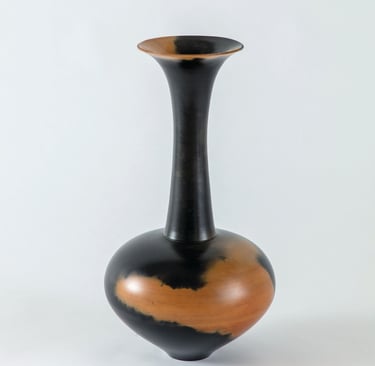
Her vessels are unmistakable.
Tall.
Burnished.
Deeply curved.
They look almost like bodies.
The surface is polished until it glows, not with glaze but with labour. With touch. With patience. Each piece is coiled slowly by hand, burnished with a stone, then fired until the clay shifts colour into deep reds and dark metallic blacks.
When you stand in front of one, something curious happens.
It feels both ancient and futuristic.
Like an artefact from a civilisation that has not yet happened.
The Intelligence of the Hand
What Odundo does with clay is the same intelligence that lives in weaving.
The same intelligence that exists in Kenyan basketry.
Coiling.
Tension.
Structure.
Balance.
These are not decorative techniques.
They are engineering systems carried in the hands of those who make.
A basket holds its form because tension distributes weight through fibre.
A ceramic vessel stands because curvature distributes pressure through clay.
Both are quiet demonstrations of physics.
And historically these systems were carried by people whose knowledge rarely entered design schools.
Women.
Communities.
Makers whose work was called “craft”, a word that often meant undervalued technology.
When Fashion Looks Toward Craft
Fashion periodically rediscovers this world.
Designers become fascinated with weaving, ceramics or hand processes, and suddenly craft appears again on runways.
Sometimes superficially.
Sometimes seriously.
Anderson belongs to the second category.
His work consistently pulls fashion toward artists and makers rather than away from them.
When woven structures appear inside luxury collections, raffia bags, leather basket forms, sculptural trunks, he is quietly reminding the industry that the future of design may still depend on the intelligence of the hand.
Not everything can be replaced by industrial production.
Not everything should be.
Fashion can be serious, but it can also remain playful. Anderson often brings bold colours and moments of humour into his work; a pair of frog shoes once made the rounds online.
That balance matters.
Design can think deeply and still remain joyful.
The Long Line of Makers
Global design culture often celebrates craft only when it becomes visible through luxury fashion.
But the masters of these traditions were never waiting for fashion’s permission.
Magdalene Odundo has spent decades shaping clay with quiet precision.
Kenyan weavers have spent centuries refining basket structures that distribute weight with remarkable efficiency.
Potters and fibre makers across Africa, Asia and Latin America have developed material knowledge that rivals any design laboratory.
And yet their work is often labelled simply:
“Traditional.”
Which usually means:
Not yet fully understood.
Excellence Recognises Excellence
Something else happens when designers like Anderson turn toward craft.
Excellence recognises excellence.
The best designers understand that innovation rarely appears from nowhere. It emerges from deep study, from observing how materials behave in the hands of people who have worked them for generations.
This is where craft becomes more than heritage.
It becomes infrastructure for design thinking.
A ceramic vessel.
A woven basket.
A fashion garment.
Each contains information.
Each carries a long memory of material experimentation.
Ni Wetu — En Marwa
So this week, as fashion circles back toward craft, I find myself thinking about Magdalene Odundo.
A Kenyan woman who has spent decades shaping clay into vessels that feel almost alive.
Quietly.
Patiently.
Without spectacle.
Yet her work sits in the greatest museums in the world. She is Dame Magdalene.
And so proudly, there is a Luo phrase I keep returning to.
En marwa. In Swahili, Ni wetu, means she is ours.
Not as ownership, but as recognition.
A reminder that some of the most important design knowledge in the world still lives in the hands of makers who began far from the runways of Paris.
And that perhaps the future of design will depend on learning to listen to them again.
E — EYE
Clay Before Cloth
Watching the Dior show this week, I kept returning to the same thought.
Some of the silhouettes looked like vessels.
Narrow openings.
A swelling centre.
A controlled base.
The geometry felt familiar.
Later I realised why.
The proportions echoed the ceramic forms of Magdalene Odundo, vessels whose curves stabilise themselves through balance rather than rigid structure.
Fashion often describes sculptural garments as “architectural”. But ceramics may be the more accurate comparison.
A potter understands something every designer eventually confronts: how a material holds space.
Clay must support its own weight as it rises. Too much outward pressure and the form collapses. Too little curvature and it becomes stiff.
Fabric behaves in surprisingly similar ways when designers attempt sculptural garments.
Volume must be balanced.
Curves must stabilise themselves.
In that sense, couture occasionally borrows its geometry from objects that were never meant to be clothing.
The vessel came first.
The gown arrived later.
Sometimes fashion remembers this.
A — ARCHIVE
Cristóbal Balenciaga
In the mid-twentieth century, the Spanish couturier Cristóbal Balenciaga began creating garments that behaved more like sculpture than clothing.
Balloon jackets.
Cocoon coats.
Barrel silhouettes.
These shapes lifted away from the body, creating volumes that held themselves through proportion rather than tight tailoring.
Balenciaga understood something fundamental: fabric could be engineered to occupy space.
Seen today, many of these silhouettes resemble vessels.
The connection between ceramics and couture was already there, fashion just did not always recognise it.
V — VOICE
Working With Material Systems
One constraint I am increasingly aware of in my own work is this:
How do we talk about craft without romanticising it?
Craft is often described through nostalgia. Tradition. Heritage.
But the systems behind it are far more precise than those words suggest.
Weaving is engineering.
Pottery is structural physics.
The challenge is to write about these practices with the seriousness they deserve, without removing the human stories that sustain them.
I suspect this tension will stay with me for a long time.
E — ECHO
What other forms already perfected in craft traditions are quietly shaping the future of design?