
WEAVE - WEEK 4 Time Is a Production Variable
Blog post description.
MATERIAL SYSTEMSCRAFT PRODUCTIONDISTRIBUTED PRODUCTIONDESIGN THINKING
3/9/20266 min read
WEAVE
Time Is a Production Variable
Industrial production assumes time is uniform.
Distributed craft systems operate inside seasonal, environmental, and social rhythms that reshape how production actually occurs.
“Production does not sit outside these systems. It is embedded within them.”
W — WORK
Seasonal Time and the Limits of Uniform Scheduling
Industrial production treats time as uniform.
Hours are divisible. Shifts are repeatable. Output is forecastable.
Contemporary design markets inherit this assumption. Lead times are calculated in weeks. Delivery dates are fixed in advance. When delays occur, they are interpreted as inefficiency.
Distributed production systems operate differently.
They operate within a seasonal time.
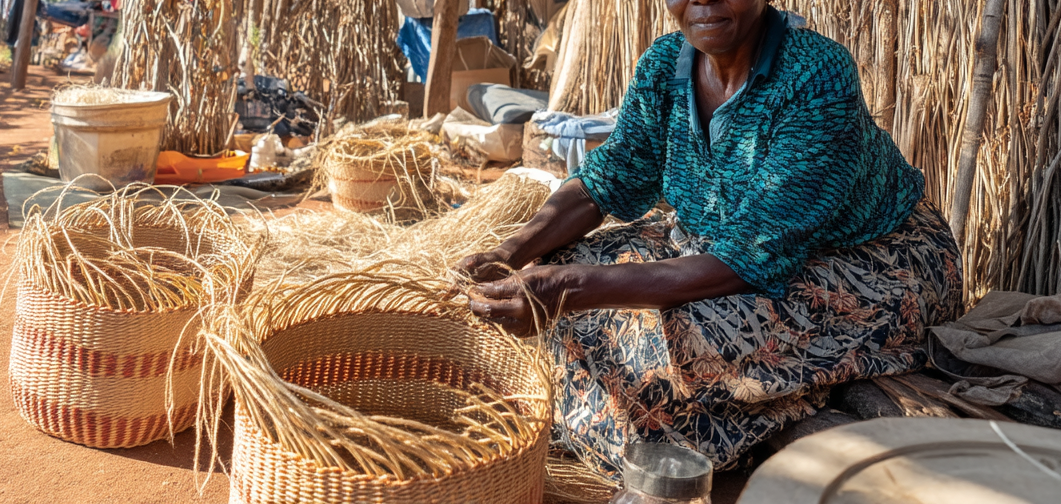
Mwende’s order is progressing steadily. The forms are consistent, the fibre prepared, the handles measured. But frequent morning rains are delaying the drying of dyed sisal. Damp fibre is not encouraged. High moisture alters tension in the weave, causing bunching, unevenness, and distortion in dye saturation. Work does not stop entirely, but it slows. Quality checks take longer. The final bundling tightens against a transport day that does not move.
The pressure appears at the end, not at the beginning.
The delay is not inefficiency. It is environmental sequencing.
Daylight marks the beginning of work. Light enables visual accuracy; tension cannot be judged properly in dim conditions. Daylight also indicates community availability. Work must align with school departures, livestock care, water collection, and food preparation. Production does not sit outside these systems. It is embedded within them.
Rain operates at two scales: seasonal and daily.
Seasonally, rainfall determines food security. Agricultural preparation and planting cycles take priority before and during the rains. Labour reallocates. Time invested in fields ensures stability during the dry season. Production capacity shifts accordingly.
Day to day, rain affects fibre processing. Sisal requires sun for drying after dyeing or soaking. Extended rain slows this stage. Heavy rain can damage stored fibre if not protected. In drought conditions, rain harvesting becomes a priority, again reordering available hours. Environmental variability does not interrupt production arbitrarily; it reshapes its sequence.
Agricultural cycles also affect labour distribution. During planting and harvest periods, time is redirected toward subsistence. Weaving continues, but its rhythm adjusts. Output fluctuates not because the organisation collapses, but because priorities are sequenced differently.
School schedules introduce another layer. Morning and afternoon runs structure the day. Parents of younger children must accommodate fixed education hours. Older children may assist marginally during holidays, but are unavailable during term. Production is therefore modulated by the academic calendar.
Transport batching adds a further constraint. Finished bags are assembled and collected at a designated point on agreed days. Transport does not operate continuously; it operates periodically. When environmental delays compress available preparation time, the fixed transport day becomes the point of tension.
None of these conditions are random. They are known variables.
Factory production operates under a different temporal architecture. Artificial lighting neutralises day–night transitions. Climate control reduces moisture variability. Shift systems extend labour beyond daylight. Overtime is introduced when output falls behind. Inventory buffers absorb fluctuation. Predictive scheduling models future supply gaps and compensates in advance.
Uniform time is engineered.
Seasonal time is negotiated.
Industrial systems reduce environmental influence by controlling it. Distributed systems do not eliminate environmental variability; they coordinate with it.
The mismatch occurs when uniform-time expectations are imposed onto seasonal-time systems. Lead times are calculated without accounting for rainfall. Delivery deadlines assume uninterrupted daylight-equivalent labour. Agricultural seasons are treated as peripheral rather than structural.
What appears as a delay is often recalibration.
Understanding time as a production variable requires a different posture. It requires steady demand rather than sporadic pressure. It requires flexible batching rather than rigid dispatch dates. It requires recognising when slower periods can be stabilised with design planning or material preparation rather than compressing output at the final stage.
Time is not a neutral container in production. It is an environmental force.
Systems designed for uniform time destabilise those built on seasonal time.
Production delays in distributed systems are often misread because they are measured against the wrong clock.
Industrial time assumes uniform conditions.
Craft production operates within ecological time.
Rain, daylight, agricultural cycles, and household responsibilities are not disruptions to production. They are part of the system that enables production.
When design begins to recognise this, time no longer becomes a constraint.
It becomes a production variable.
UNIFORM TIME (Engineered)
SEASONAL TIME (Negotiated)
Clock-based
Environment-based
Shift rotation
Daylight-dependent
Climate controlled
Weather variable
Inventory buffer
Batch dependent
Predictive scheduling
Environmental sequencing
Overtime adjustment
Labour redistribution
Fixed dispatch dates
Transport batching
Fig_1
Fig_2
E — Eye
What caught my attention this week was wool, specifically shearling.
Shearling is not sentimental. It is material intelligence. A sheep or lamb skin tanned with the wool still attached: suede on one side, clipped fleece on the other. Warm, durable, breathable. It regulates rather than traps. It ages rather than collapses. That is why it persists in serious winter outerwear.
My old slippers had reached the end of their tenure. For months, they have been the subject of a domestic contest between our me and our border terrier puppy, who, to be fair, has excellent taste. She recognises quality before marketing does. Left unsupervised, she will dismantle shearling with clinical focus. I am surprised any of mine survived.
We are fortunate here in the UK, wool is not exotic. It is local. There is even a factory not far from us that specialises in slippers. For nearly a decade, I bought the same brand, cycling through designs that were structurally sound and aesthetically restrained. No complaints. Just fatigue. When something is faultless, boredom becomes the only friction.
So, I stepped into the open market, the internet, which is a polite way of saying uncertainty.
Claims multiply online. “Genuine shearling.” “Premium leather.” “Luxury.” These words are elastic. You have to read carefully. Check fibre density. Confirm whether it is double-faced shearling or synthetic lining. Examine sole construction. Ask where the hide is sourced. Material literacy is now a survival skill.
The upper matters. Full-grain leather costs more for a reason. Suede, when properly finished, is my preference: soft but structured. Then the fleece: thick enough to insulate, not so bulky it loses shape.
I chose an Australian brand whose quality-to-price ratio felt honest. Not theatrical. Just correct.
Design-wise, the field is predictable:
– open mule
– closed shoe
– high-top (too architectural for my needs)
Then the practical question: indoor-only sole, or something that tolerates stepping outside? I chose the latter. I want to walk to the bins without changing shoes. Civilisation is built on such small decisions.
Material, function, proportion. That is the hierarchy.
Good design is simply knowing what you are actually paying for.
A — Archive
Yellowstone
At the moment, I have one reaction: Oh.
It has been a while since a series held my attention past the first cautious ten minutes. The last that did so was The Bear, relentless, intimate, almost claustrophobic in its moral pressure.
Yellowstone works differently. It is expansive. The camera breathes. The land is not background; it is a protagonist. And yet the pull is the same: flawed people you choose to stay with.
The Duttons are not clean heroes. They are territorial, compromised, and sometimes brutal. But they are persistent. There is grit here, not aesthetic grit, but existential grit. The sense that something must be defended, even if the defence is imperfect.
What lingers is not the violence. It is the question of stewardship. This, like production, is about time horizons.
Who protects land?
Who decides what development costs?
Who absorbs the pressure of markets, politics, inheritance?
The series does not offer robust moral resolution. Good does not neatly triumph. But it threads something quieter through the conflict, endurance. A belief that holding ground matters.
In this moment, geopolitics destabilises, technology accelerates beyond governance, extremism finds volume, and narratives of protection feel necessary. Not nostalgic, not naive. Necessary.
The show is not subtle about masculinity, nor entirely generous in its political framing. But it understands something elemental: land, family, power, survival. These are not abstract debates. They are lived tensions.
And perhaps that is why it works.
We are not watching for purity.
We are watching for persistence.
Hope, here, is not idealism. It is the refusal to leave the field.
V — Voice
Locally Met Material Needs
The idea of Kenyan-made sits close to me, not as a slogan, but as a structure.
Place-specific craft does something powerful. It forces negotiation. It sharpens skills over time. It allows production systems to evolve in response to climate, labour rhythms, and lived use. In that sense, it builds capability, not just product.
But the tension appears at the premium edge.
Hardware. Fastenings. Zips. Rivets. Branded elements. The invisible infrastructure of luxury is rarely homegrown. These components carry technical requirements: consistency, durability, and finish, which are not always locally manufactured at scale.
So, the question is not ideological. It is strategic.
What must be local to hold integrity?
What can be imported without weakening the system?
What we consider to be true localisation is not purity. It is intelligent calibration.
E — Echo
What endures is what learns to move with its conditions.