
WEAVE - WEEK 15: THE FICTION OF SEAMLESSNESS
Luxury branding often hides labour. What happens when we reveal the process instead?
6/19/20265 min read
WEAVE - WEEK 15: THE FICTION OF SEAMLESSNESS
An ongoing series on material systems, labour, and design.
W — WORK
Luxury often presents itself as effortless.
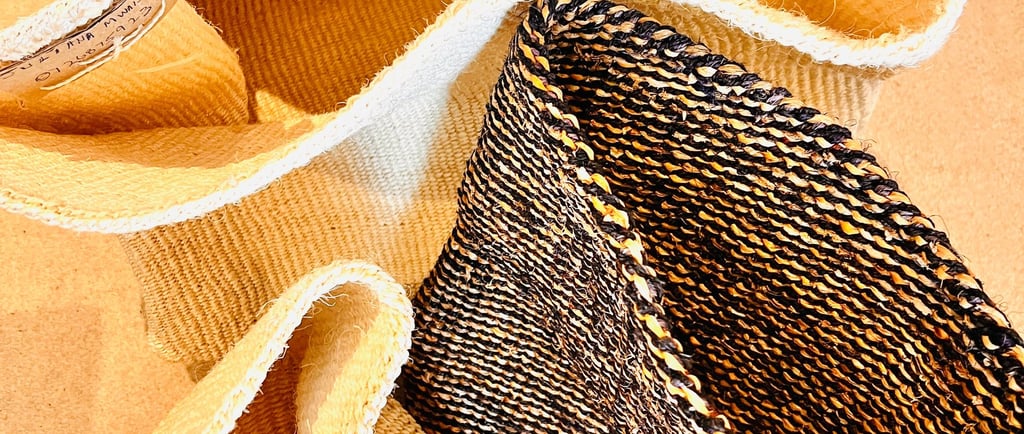
A beautifully woven basket sits in a sunlit room. A leather bag rests casually on a chair. A garment drapes perfectly across a body. The object appears complete, self-contained, almost inevitable.
What is missing is the work.
Not the romanticised work of artisanship that occasionally appears in marketing campaigns, but the repetitive, physical, often tedious labour that makes the finished object possible in the first place.
Recently, I sat with Kathuka as she prepared sisal for weaving.
Before a single stitch could be made, there was fibre preparation. Hundreds, perhaps thousands, of strands would need to be twisted before they could become part of a kiondo. The strength of the bag, the texture of the weave, and the distinctive aesthetic that defines the object all depend on this seemingly simple process.
A small bundle of fibres is selected and twisted into a coil. Another is prepared in the same way. The two are then tensioned against each other, creating a miniature rope strong enough to weave with.
This is not an optional step.
Without it, there is no kiondo.
The twisting is traditionally done on the thigh. Sisal is abrasive. The fibres can irritate the skin, and the work is repetitive and demanding. Watching Kathuka, I found myself wondering whether there might be an easier way.
Could a simple device help?
Could leather replace skin as the surface against which the fibres are twisted?
Could a low-cost tool reduce the strain?
Kathuka smiled patiently.
"We have tried many things," she said.
Then she returned to her work.
"The easiest way is how we traditionally do it."
It was a reminder that innovation and improvement are not always the same thing. Sometimes a process survives because it remains the most practical solution available. Sometimes tradition contains a form of accumulated knowledge that outsiders struggle to recognise.
Yet what struck me most was how invisible this labour is.
Nobody buying a kiondo sees the hours spent preparing fibre.
Nobody sees the calloused hands and thighs.
Nobody sees the repetitive motions.
Nobody sees the work that happens before the work.
Instead, they see a finished object.
And that invisibility is not unique to basketry.
Luxury has long relied on an aura of effortlessness.
Luxury often presents itself as effortless.
The finished product is presented as flawless and inevitable, while the complicated reality of production quietly disappears from view. Supply chains stretch across continents. Materials travel thousands of miles. Components pass through multiple hands. Samples fail. Colours are tested. Prototypes are rejected. Delays occur. Repairs are made.
Yet the final story is often reduced to a single image and a logo.
The less visible the process becomes, the more seamless the object appears.
For decades, this worked.
Luxury operated on aspiration. Customers bought into a vision of refinement, exclusivity, and ease. The reality behind the curtain was rarely discussed.
Today, however, something is changing.
Consumers are increasingly interested in provenance as much as product. They want to know where materials come from, who made the object, and how it was produced. Questions about labour conditions, environmental impact, and fair compensation have moved from the margins into the mainstream.
When we look closely at a handwoven basket, a ceramic vessel, or a hand-stitched garment, we begin to see something that industrial production often hides: time.
Every object represents accumulated hours of human attention.
At PAM YO!, that process begins long before a bag reaches a customer.
It starts with sisal plants growing under the East African sun. The leaves are harvested and stripped to reveal strong inner fibres. Those fibres are cleaned, sorted, dried, twisted, dyed, and prepared before weaving can even begin.
The weaving itself requires concentration, rhythm, and experience. The maker continuously adjusts tension, shape, and structure as the form slowly emerges. Handles are attached. Leather components are cut and finished. Labels are added. The finished bag is inspected, packed, photographed, and eventually shipped.
Each stage contains its own expertise.
Each stage contains labour.
Each stage contains time.
None of it is seamless.
And perhaps that is precisely the point.
Perhaps luxury is not the absence of labour.
Perhaps luxury is understanding and valuing it.
Not simply the finished object, but the human knowledge, patience, repetition, and skill required to bring it into existence.
Seamlessness may be beautiful.
But so is the process it conceals.
E — Eye
David Hockney
I first encountered David Hockney through a few colourful splashes of paint hanging on a wall in my father-in-law's home. As a design student in Kenya, I had spent most of my time studying the Old Masters. Contemporary art felt like a vast territory that I had yet to explore.
Over the years, however, Hockney kept appearing.
An exhibition here. A documentary there. A landscape series that everyone seemed to be discussing. Each time, the art world returned to him with renewed enthusiasm.
His paintings are remarkable, but I have increasingly found myself drawn to the man himself. His personal style is instantly recognisable: thick glasses, braces, checked shirts, tweed jackets, brightly coloured knitwear, and, quite often, a cigarette. Hockney has documented himself in more than 300 self-portraits, creating a visual archive not only of an artist's face but of a life lived unapologetically on his own terms.
King Charles reportedly once admired a pair of Hockney's yellow goloshes, remarking, "Your yellow goloshes! Beautifully chosen."
Few artists have managed to make individuality look so effortless.
Perhaps that is why Hockney remains relevant. His work celebrates careful observation of the world, while his life reminds us that style is not about fashion. It is about consistency, curiosity, and the confidence to remain recognisably oneself.
A — Archive
The Red Coat
I was washing my hands at Heathrow Airport when a flash of red caught my eye.
Standing beside me was a woman wearing the most magnificent coat. Sharp tailoring. Perfect colour. Instantly memorable.
"Oh wow, I love your coat," I said.
She laughed.
"Thanks. It's the uniform."
The uniform?
I was genuinely shocked.
The coat belonged to Virgin Atlantic's cabin crew uniform collection, redesigned by Vivienne Westwood. Somehow, I had missed this entirely.
The collaboration made perfect sense. Both brands built their reputations on challenging convention and injecting personality into spaces often dominated by conformity.
It was a reminder that design lives everywhere. Sometimes in galleries. Sometimes on runways. And sometimes unexpectedly, in an airport washroom.
V — Voice
Speed and Action
Running a business across countries has taught me that decisions have a surprisingly short shelf life.
A meeting takes place. Good ideas emerge. Agreement is reached. Everyone leaves energised.
Then nothing happens.
Or rather, things happen slowly.
Instructions are relayed through multiple people. Details are forgotten. Assumptions are made. The original decision gradually changes shape until someone has to revisit the discussion and start again.
I've become increasingly convinced that speed is underrated. Not reckless speed, but decisive movement.
A clear decision followed by immediate action often beats a perfect decision delayed by weeks of discussion.
Momentum is not just operational.
It is cultural.
The longer a decision sits, the harder it becomes to remember why it mattered in the first place.
E — Echo
Are we really ready to unpack the reality of how our consumption is made?
TAGS
Craft
Design
Production Systems
Supply Chain
African Design
Material Culture
Social Innovation