
WEAVE - WEEK 14: THE GEOGRAPHY OF MAKING
How roads, ports, distance, climate, and infrastructure shape objects before design decisions begin.
6/13/20264 min read
WEAVE - WEEK 14: The Geography of Making
An ongoing series on material systems, labour, and design.
W — Work
How roads, ports, distance, climate, and infrastructure shape objects before design decisions begin.
Design often begins with an object.
A basket.
A chair.
A garment.
A building.
The assumption is that someone designed it, selected materials, refined proportions, and made a series of decisions that eventually resulted in a finished product.
Every object carries a map within it.
But long before design begins, geography has already made many of the decisions.
Mueni's Dilemma
Several weeks ago, we met with a group of weavers in Ukambani. As part of the discussion, each woman brought work she was particularly proud of: pieces that represented her skill, experimentation, and personal style.
Mueni's basket stood out immediately.
The form itself was simple and exceptionally neat. What drew attention were the details woven into the upper third of the basket. Alongside the familiar sisal fibre, she had incorporated strands of baobab and banana fibre, creating subtle shifts in texture and colour that transformed an otherwise familiar object.
The design was selected for development.
A new order was placed, measurements agreed, and Mueni was asked to help guide production so that other weavers could reproduce the same detailing consistently.
From a design perspective, the decision appeared straightforward.
From a geographical perspective, it was anything but.
Mueni should have been celebrating.
Her basket had been chosen.
In craft economies, selection carries a peculiar kind of honour. It means that something you did instinctively, a slightly different edge, a better finish, an unexpected combination of fibres, has been noticed.
Instead, she was worried.
Not about weaving.
About finding baobab.
Before weaving can begin, Mueni must source materials. Sisal is readily available. Banana fibre can usually be obtained through local networks. Baobab fibre is more complicated.
Its availability depends on market days.
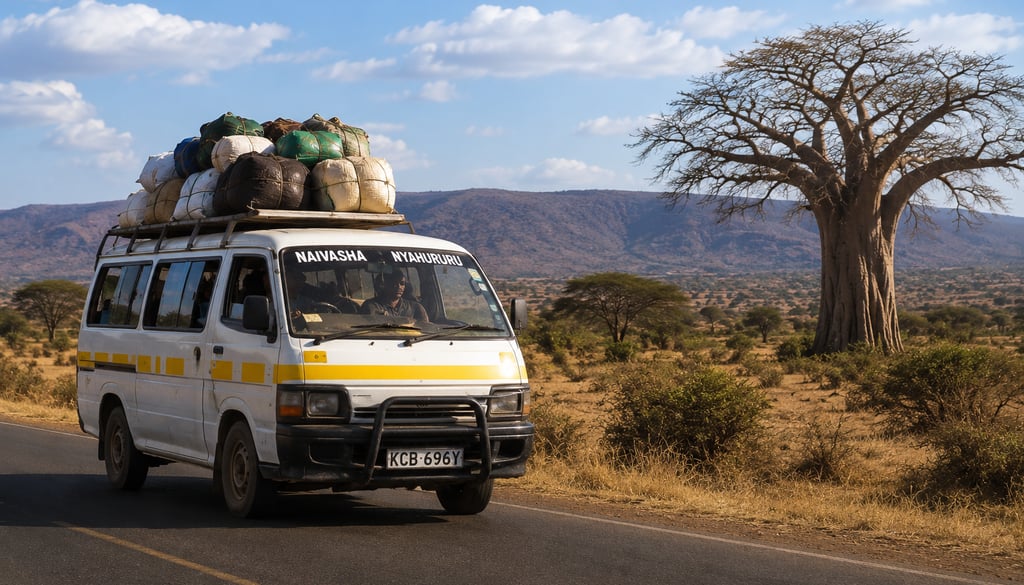
During periods of heavy rainfall, suppliers may not arrive. Roads become difficult. Transport costs rise. A missed market day can delay production for a week or more. Sometimes the solution is to travel further. Sometimes it means paying a premium. Occasionally, it means waiting.
The basket remains unfinished, not because of a design problem but because of geography.
This is the hidden reality of many craft economies.
The geography of making extends far beyond maps and locations. It shapes access to materials, movement of knowledge, production timelines, pricing structures, and ultimately the objects themselves.
Four dimensions are particularly important.
The Market Day Problem
Many traditional craft systems emerge directly from the ecological conditions around them.
The materials available within a landscape often determine what can be made and how it can be made.
In Kenya, sisal, baobab, palm fibres, and reeds each belong to particular ecological zones. Elsewhere, Andean weaving traditions rely on alpaca fibres, while many historic textile traditions evolved around regionally available plants, insects, minerals, and natural dyes.
What appears to be a design choice is often an ecological relationship developed over centuries.
Materials are rarely selected from a catalogue.
They are gathered from landscapes.
Knowledge Likes Company
Craft knowledge is not distributed evenly.
It gathers.
Certain villages become known for particular techniques. Certain families become recognised for particular skills. Knowledge accumulates through proximity.
Kiondo weaving in Kenya, Kente weaving in Ghana, and Banarasi weaving in India all demonstrate how specialised knowledge becomes concentrated within communities.
Design languages, production methods, measurements, and techniques are transmitted through observation and repetition rather than documentation.
Place becomes a form of infrastructure.
The cluster itself becomes part of the production system.
When the Road Washes Away
Many artisan economies remain highly exposed to environmental conditions.
Rainfall patterns affect transport routes.
Drought affects fibre quality.
Flooding interrupts markets.
Poor roads increase costs.
Climate change amplifies existing vulnerabilities.
For large industrial manufacturers, disruptions may be absorbed through inventory systems and alternative suppliers.
For small-scale producers, a washed-out road or missed market day can have immediate consequences.
The geography of production is never neutral.
It determines who can participate, who can access markets, and who bears the greatest risk.
The Landscape Inside the Object
Geography shapes more than resources.
It shapes meaning.
Different regions develop their own visual languages, symbolic motifs, colour systems, measurements, and relationships to material culture.
These traditions are not simply decorative.
They are ways of understanding the world.
As global supply chains become increasingly standardised, these local design languages become more valuable and more vulnerable at the same time.
To understand a basket fully requires understanding the landscape that produced it.
The object is only the visible part of a much larger geography.
Every object carries a map within it.
The roads, markets, seasons, fibres, skills, and relationships that made it possible remain largely invisible.
Yet they are present in every stitch, weave, and surface.
Long before design begins, geography is already making decisions.
E — Eye
Iris Van Herpen
I came across Iris van Herpen's Dorhni dress while scrolling through Instagram and immediately stopped.
The piece takes inspiration from Turritopsis dohrnii, often referred to as the immortal jellyfish for its remarkable ability to revert to an earlier life-cycle stage.
What interested me wasn't the technology. It was the biology.
Even among the most futuristic designers working today, the source material remains stubbornly ancient. Oceans. Fungi. Connective tissue. Shells. Plankton. Evolution itself.
The future, it turns out, remains deeply provincial.
It still begins somewhere.
Even the most futuristic designer is still drawing from biological systems, oceans, fungi, connective tissue, and planetary forms. The future remains rooted in place.
A — Archive
Sympoiesis
Sympoiesis means "making-with." Unlike systems that imagine independent actors, sympoiesis suggests that things emerge through relationships. Species, materials, technologies, landscapes and people continually co-create one another. In a week focused on geography, the concept matters because no object is made alone. Every basket, building or garment is the product of a larger web of places, materials, infrastructures and lives.
Every object carries a map within it.
V — Voice
Small Teams and Holidays.
What happens when the founder leaves? Which systems continue, and which suddenly reveal themselves? A holiday is often the first real stress test of an organisation. It reveals whether a business is a system or simply a person carrying a system in their head.
Small teams become interesting when someone leaves.
Not permanently. Just for a week.
A holiday has a way of exposing organisational fiction. Processes that seemed robust suddenly reveal themselves to be habits. Systems reveal themselves to be memory. Delegation reveals itself to be wishful thinking.
Perhaps every founder should take a holiday sooner rather than later.
It is one of the fastest organisational audits available.
E — Echo
What would our objects look like if we mapped every road, market, season and relationship that helped make them?
TAGS
Craft
Design
Production Systems
Supply Chain
African Design
Material Culture
Social Innovation