
WEAVE — WEEK 13: REPAIR IS DESIGN
Why repairability may become the defining luxury principle of the next decade.
DESIGN THINKINGDISTRIBUTED PRODUCTIONMATERIAL SYSTEMSCRAFT PRODUCTIONPEOPLE
5/29/20264 min read
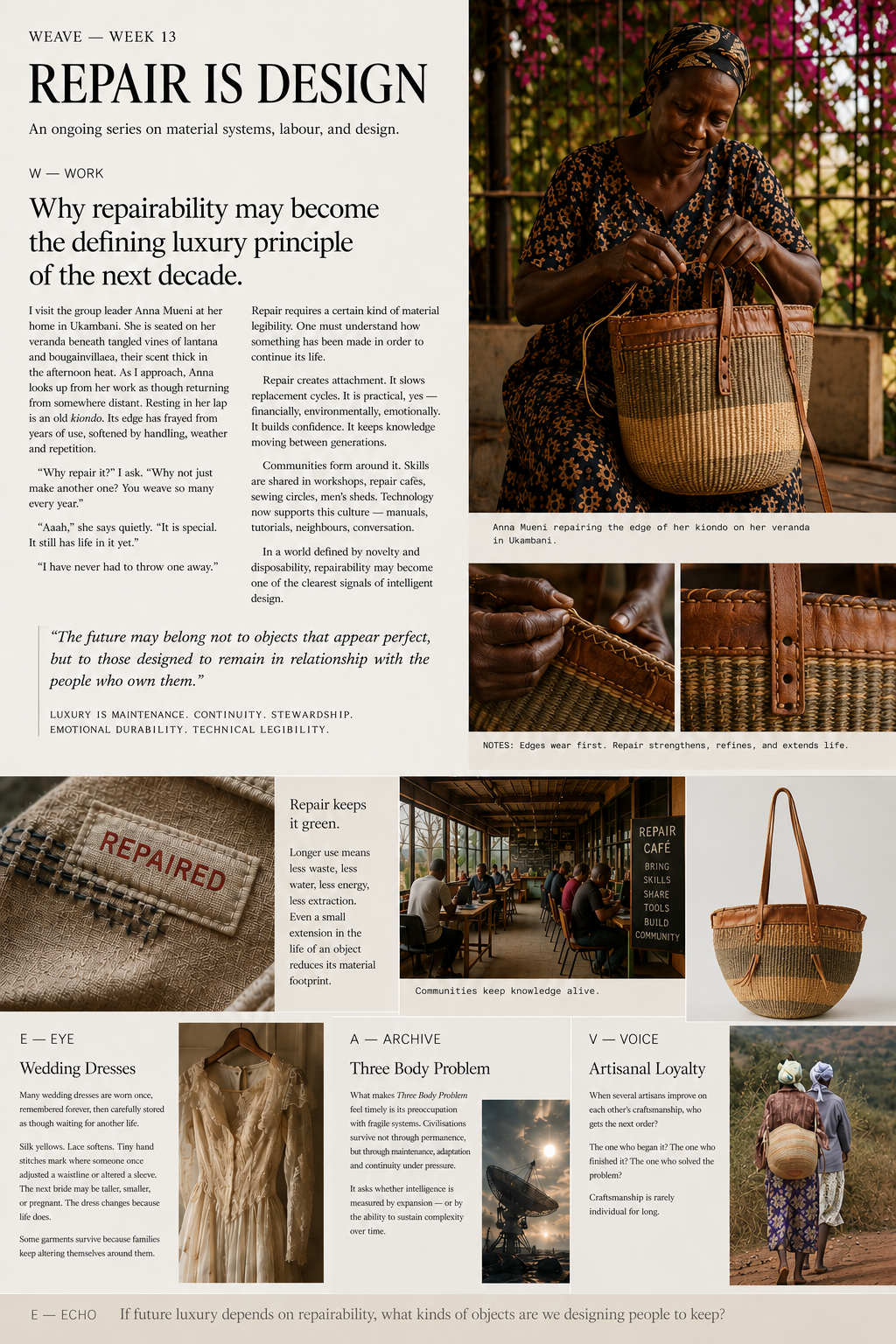
WEAVE — WEEK 13: Repair Is Design
An ongoing series on material systems, labour, and design.
W — WORK
Why repairability may become the defining luxury principle of the next decade.
I visit the group leader Anna Mueni at her home in Ukambani. She is seated on her veranda beneath tangled vines of lantana and bougainvillaea, their scent thick in the afternoon heat. The bougainvillaea appears intentional; the lantana less so. Here, certain things simply insist on remaining.
As I approach, Anna looks up from her work as though returning from somewhere distant. Resting in her lap is an old kiondo. Its edge has frayed from years of use, softened by handling, weather and repetition. Because it is a large basket, she explains, she is reducing it slightly before reworking the border into a new edge finish. The repair will strengthen the structure, but also improve the appearance.
“Why repair it?” I ask. “Why not just make another one? You weave so many every year.”
“Aaah,” she says quietly. “It is special. It still has life in it yet.”
Then she adds something even more striking.
“I have never had to throw one away.”
For a moment, the basket ceases to be a product. It becomes evidence of another relationship with objects entirely.
Repair requires a certain kind of material legibility. One must understand how something has been made in order to continue its life. Anna can repair the basket because its logic remains visible to her. Nothing is sealed. Nothing is hidden behind proprietary layers or inaccessible systems. The object can still speak back to the maker.
Modern consumption often positions us as passive recipients of finished goods. We purchase. We use. We discard. Increasingly, products arrive closed to us — glued shut, technologically opaque, difficult to open, difficult to diagnose, difficult to maintain. Their lifespan is frequently determined long before they enter our homes.
Yet older material cultures assumed continuity. Wear was anticipated. Maintenance was expected. Repair was not evidence of failure, but part of ownership itself.
Perhaps this is why repaired objects often carry unusual emotional weight. We choose certain things because their form, texture or usefulness speaks to us. Over time they absorb memory. A softened leather handle. A faded collar. A patched sleeve. The small marks of continued living.
Some objects become more convincing with age.
I have occasionally repaired items before even using them properly. A loose stitch. A faulty clasp. A slight imperfection. Yet none of these diminished the object in my eyes. If anything, repair deepened my attachment to it. Care creates intimacy.
Financial practicality also plays a role, of course. Replacing a handle, patching a seam or repairing a sole is often significantly cheaper than purchasing something entirely new. But repair is not simply about thrift. It is about extending usefulness. Protecting investment. Refusing unnecessary replacement.
There is environmental significance too, though the conversation is often reduced to slogans. The reality is more physical than moral. Every replacement object requires fibre, water, energy, dye, transport and labour. Textile bleaching contaminates rivers. Synthetic waste accumulates quietly at enormous scale. Repair slows these cycles down. Even a modest extension in an object’s usable life can meaningfully reduce its material footprint.
But perhaps the most overlooked aspect of repair is psychological.
Manual mending demands attention. It slows the body. There is concentration in threading a needle, sanding a surface, reinforcing a corner or diagnosing why something no longer functions properly. Repair encourages presence. Patience. Observation. One begins to understand not only the object, but the systems beneath it.
This kind of practical intelligence once moved fluidly between generations. Skills travelled through households, workshops and communities. Today, fragments of that culture remain visible in repair cafés, tailoring stalls, reupholstery shops, men’s sheds, knitting circles and informal neighbourhood exchanges. People gather not only to fix things, but to exchange knowledge. To remain useful to one another.
Repair creates community because repair depends on shared understanding.
Technology, interestingly, may now be reviving some of this culture rather than destroying it entirely. Crowdsourced platforms such as iFixit provide detailed repair manuals. Tutorials circulate endlessly online. One can ask YouTube, Google, ChatGPT, or simply a neighbour. The desire to understand how things work has not disappeared. It has merely been displaced.
What is changing now is the meaning of luxury itself.
For decades, luxury has increasingly attached itself to novelty: seasonal drops, endless consumption, rapid aesthetic turnover and the performance of newness. Yet this model feels strangely exhausted. More and more, truly desirable objects are those that survive continued care.
The future may belong not to objects that appear perfect, but to those designed to remain in relationship with the people who own them.
Repairability may ultimately become one of the clearest signals of intelligent design.
Not because it is nostalgic.
But because it assumes continuity.
And continuity, increasingly, is luxury.
E — Eye
Wedding Dresses
Wedding dresses occupy a strange position among garments. They are worn once, remembered forever, then carefully stored as though waiting for another life to begin.
The older dresses interest me most.
Many survive not because they remain fashionable, but because families cannot quite bear to let them go. Silk yellows slightly. Lace softens. Tiny hand stitches appear where someone once adjusted a waistline or altered a sleeve. Sometimes the next bride is taller. Sometimes smaller. Sometimes pregnant. The dress changes because life does.
In certain families, particularly where the original gown was expensive, dresses move quietly across generations. Daughters inherit them. Tailors reshape them. Sections are removed, added, softened or modernised. Yet traces of previous wearers remain embedded in the fabric.
A wedding dress may begin as fashion.
But over time, it becomes evident that several lives managed to continue.
Some garments survive because families keep altering themselves around them.
A — Archive
Three Body Problem
What makes Three Body Problem feel timely is not simply its scale, but its preoccupation with fragile systems. Civilisations survive not through permanence, but through maintenance, adaptation and continuity under pressure. The series constantly returns to the question of whether intelligence is measured by expansion alone, or by the ability to sustain complex systems over time.
It feels unexpectedly relevant in an era increasingly defined by disposability.
V — Voice
Artisanal Loyalty
One of the more difficult realities within distributed craft systems emerges when several artisans begin improving one another’s work.
A basket passes through multiple hands. One weaver strengthens the structure. Another refines the finish. Someone else solves the handle attachment more elegantly. Gradually, the object improves collectively.
But then comes the difficult question.
Who receives the next order?
The original maker?
The strongest finisher?
The fastest producer?
The person whose intervention elevated the work most significantly?
Craftsmanship is rarely individual for long.
E — Echo
A future question
If future luxury depends on repairability, what kinds of objects are we designing people to keep?
TAGS
Craft
Design
Production Systems
Supply Chain
African Design
Material Culture
Social Innovation