WEAVE — WEEK 12 BUILDING WITH, NOT OVER
The task is not to “bring structure” to places where structure already exists.
5/22/20264 min read
WEAVE — WEEK 12: BUILDING WITH, NOT OVER
An ongoing series on material systems, labour, and design.
W — WORK
BUILDING WITH, NOT OVER
The task is not to “bring structure” to places where structure already exists.
The work continues in Kitui, with production already moving.
When an order is due, delays are almost always on the office or weaving side. No side is infallible. This week was a case in point when the country yet again descended into street rioting over escalating fuel prices. Kenya not only has the highest fuel prices in Africa but the government, instead of assisting, seems to be keen on keeping it high. The riots halted public transport, so the completed bags could not travel. They were ready, but the office could not operate. When there was a window, the bags were sent, even before we had arranged payment. The women carried on with the task at hand.
The task is to recognise the intelligence already holding things together, and build around it with care.
Before the form arrives, there is already a system.
Before the workshop, there is already instruction.
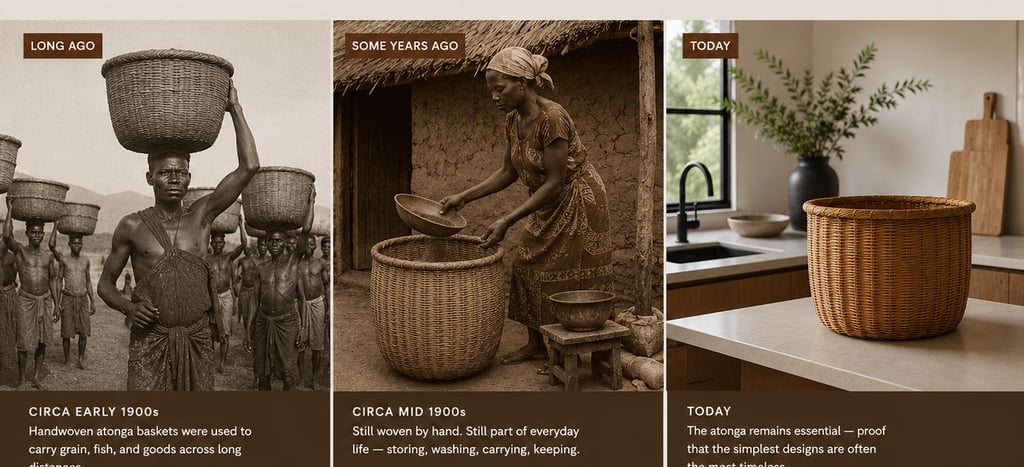
Before the brand, the basket has already passed through soil, fibre, hand, judgement, memory, and exchange.
The Language of Institutions: “scaling","formalising", "empowering", and "integrating"
Institutions often arrive with language such as "scaling", "formalising", "empowering", and "integrating". There is a tendency to try to build over existing systems because those systems do not look official enough.
The question is not: How do we modernise this?
The better question is: What is already working here, and what would make it stronger without distorting it?
Existing systems are not empty space. The assumption is to treat Informal production working in institutional absence. When we do not see records, a built and working factory, no tight and unwavering contracts, no forms of rigid standardisation. But absence of paperwork is not absence of order.
Design should translate, not overwrite. In informal production, good design makes use of, and also makes existing intelligence legible to new markets without stripping it of its logic. It is therefore important that Institutions must learn to see before they intervene.
There is a tendency for governments, NGOs, and brands to often want measurable outputs too quickly. But good support begins with observation.
Building with the proper engagement in informal systems requires slower power. In essence, it means more shared risk, patient coordination, and respect for knowledge that was not written down.
To build with, not over, is to accept that the future does not always begin with invention. Sometimes it begins with the humility to notice what has already survived.
E — Eye
LABELS
I have been thinking about labels lately. Not metaphorically at first, but literally. Cloth labels. Swing tags. Tiny woven strips folded over the edge of a basket. The sort of detail most people barely notice until it is wrong.
A label performs difficult work in a very small space.
Branding and labelling are often collapsed into the same idea, but they are doing different jobs. Branding builds recognition, memory, atmosphere. It persuades. A label, meanwhile, is practical. It tells you what something is, where it came from, how it should be handled, whether it belongs to this category or another. One creates emotional association; the other creates legibility.
Yet the line between them is thinner than it first appears.
A beautifully considered tag does more than organise inventory. It quietly signals seriousness. It tells you someone thought carefully about the object before it reached your hands. In luxury fashion, in supermarkets, in archives, in government systems — labels are everywhere, constantly sorting the world into knowable units.
The interesting thing is that even the most functional label eventually becomes part of the brand itself. The typography. The placement. The stitching. The material weight. The confidence of restraint. Over time, the tag stops merely describing the object and becomes inseparable from how the object is understood.
Perhaps that is true of institutions too.
The label begins as information, but eventually becomes part of belief.
A — ARCHIVE
The Book of Eels by Patrik Svensson
This week’s archive is The Book of Eels by Patrik Svensson — a strange, philosophical investigation into one of science’s oldest obsessions: where eels come from. Scientists eventually discovered that freshwater eels travel thousands of miles to the Sargasso Sea to spawn and die. Yet no human has ever witnessed the act itself.
Even Sigmund Freud dissected thousands of eels searching for reproductive organs that did not appear until the final stage of their lives. The mystery persists. Perhaps this is the difference between curiosity and conquest. The eel asks to be understood. Humans often arrive wanting to improve, organise, and control what they have barely taken the time to observe.
V — Voice
Space and time: Designing Across Continents.
There comes a point in building a company where you begin asking uncomfortable questions about sourcing. What is truly local production, and what is simply buying from China through three additional people at three additional markups? The label problem brought us directly into that territory.
A woven label looks simple until you try producing one yourself. Suddenly, there are minimum orders, thread densities, Pantone references, machine tolerances, shipping windows, and photographs arriving at 2:14 am, asking whether the crocodile should shift half a centimetre to the left.
Cutting out the middleman sounds efficient until you realise the middleman was absorbing complexity for a living.
Still, there is something strangely hopeful about people across continents attempting precision together through screens, translation apps, voice notes, and patience. Space collapses. Time stretches. Everyone adjusts slightly to meet the object halfway.
E — ECHO question
What would development look like if its first task was not to improve people, but to understand what they have already built?
TAGS
# Craft
# Design
# Production Systems
# Supply Chain
# African Design
# Material Culture
# Social Innovation