
WEAVE — WEEK 11 WHEN FORMALISATION FAILS
WHEN FORMALISATION FAILS
5/15/20264 min read
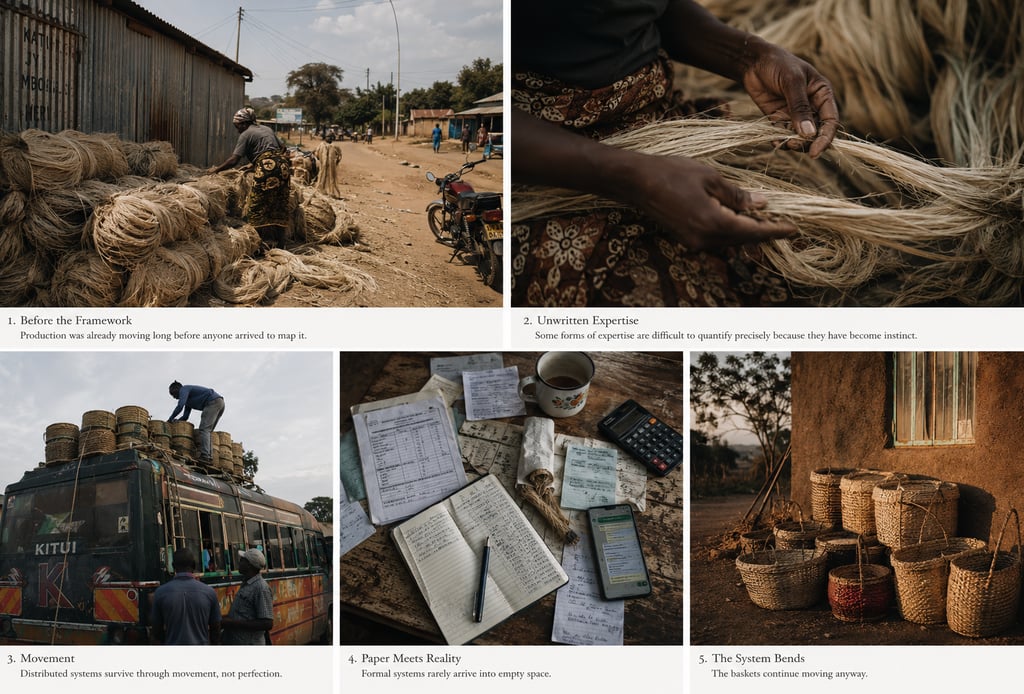
W — WORK
There is a particular theatre that accompanies paperwork.
The arrival is usually recognisable long before the meeting begins. A white vehicle eases into a trading centre somewhere in Muranga. Laptops emerge. So do terms like capacity building, market readiness, and value-chain integration. Someone unfolds a framework dense with arrows moving confidently toward a cleaner future.
The atmosphere carries a subtle assumption: that structure has finally arrived.
Yet long before the workshop starts, the system in question is already in motion.
A woman has advanced sisal fibre to her neighbour because harvesting was interrupted by a funeral. A cousin travelling to Nairobi has agreed to carry finished baskets on a night bus after the transport lorry failed to arrive again. Payment from a previous order is being quietly balanced against another delivery. Somewhere else, a delayed leather finish has already been rerouted to another artisan workshop without requiring what development language calls an “adaptive response mechanism.”
The system exists.
It simply does not resemble the systems that institutions recognise easily.
This is often where formalisation begins to fail. It is not because the structure itself is harmful, but because outside interventions frequently mistake visibility for intelligence. What cannot be mapped neatly onto a spreadsheet is interpreted as absence. Labour not formally documented is assumed to be disorganised. Distributed production is mistaken for inefficiency. Social accountability appears weak compared with contractual governance, even though entire industries continue to function precisely through these relational systems.
In places like Kitui, what outsiders often encounter is not a lack of organisation but an extraordinary density of adaptation. A production culture shaped over decades by fluctuating cash flow, unreliable roads, school fees, illness, harvest cycles, migration, weather, politics, and interruption.
None of this is especially romantic.
It is simply real.
The difficulty emerges when formalisation attempts not to understand these systems but to overwrite them. Women who previously coordinated production fluidly through relationships suddenly find themselves navigating reporting templates in formal English. Fibre schedules become rigid despite agricultural realities. Metrics begin prioritising reporting compliance over actual resilience. Slowly, the intelligence that kept the system functioning starts to be treated as administrative noise.
One hears this often in development language: the belief that efficiency naturally requires centralisation, that standardisation automatically produces quality, that visibility guarantees accountability. But distributed systems survive precisely because they remain flexible enough to absorb disruption.
A factory line may stop entirely when one machine fails. A weaving network bends. One woman falls ill; another continues the order. A transport route collapses; baskets move another way. A supplier disappears; relationships elsewhere absorb the pressure.
The system survives because it is elastic.
This is not an argument against records, accounting, or production discipline. PAM YO itself is steadily building more formal operational systems because scale eventually punishes improvisation. The question is not whether formalisation matters. The question is what kind of formalisation is being introduced, and at whose expense.
The most dangerous version extracts legibility while destroying local intelligence. It asks communities to perform professionalism according to external standards while ignoring the sophistication already present.
The better version begins more quietly.
Observation before intervention.
Listening before restructuring.
Documentation before replacement.
Not: How do we fix this?
But rather: What is already working here that we have failed to recognise?
There is a final irony in all this. Institutions now enthusiastically celebrate concepts such as decentralisation, resilience, adaptive governance, and networked systems, as though they were newly discovered ideas. Meanwhile, communities across much of the Global South have been operating this way for generations, not because it was fashionable, but because survival demanded it.
The language changed.
The intelligence did not.
Perhaps formalisation fails most profoundly when it confuses modernity with superiority. When systems carrying enormous, accumulated knowledge are required to first perform inadequately before they are considered worthy of support.
The baskets continue moving regardless. Quietly. Persistently. Along roads that most frameworks never quite manage to see.
E — EYE
At the market in Kitui, bundles of sisal rest against a corrugated metal wall, pale gold in the afternoon heat. From a distance, they appear interchangeable. But a weaver approaches them the way a sommelier approaches wine, through instinct refined into precision.
Her hands move quickly. One bundle is too brittle. Another too coarse. A third carries traces of dampness from recent rain. Some fibres have softened properly beneath the sun; others will resist the weave.
No grading chart hangs nearby. No certification mark accompanies the pile.
Only touch.
Memory.
Repetition.
Elsewhere, this might be described as technical expertise. Here, it passes almost unnoticed, folded quietly into ordinary life.
Markets have a habit of overlooking the forms of intelligence they cannot immediately quantify.
A — ARCHIVE
I keep returning to James C. Scott’s Seeing Like a State, a book that lingers long after reading because its observations feel unsettlingly familiar. Scott argues that large institutions often fail not through lack of intelligence but through excessive simplification. Forests become timber inventories. Cities become geometric grids. Communities become administrative categories.
Something essential disappears in the translation.
Reading it now, one recognises the pattern almost immediately within contemporary conversations around craft, informality, development, and production systems across much of Africa. Complexity is flattened in order to become manageable. But what becomes manageable is not always what remains alive.
V — VOICE
Lately, I have been thinking about the pressure small organisations face to imitate institutions before they have fully understood themselves.
Professionalism arrives early now. Sometimes prematurely. The polished deck. The strategic vocabulary. The reporting structures borrowed from somewhere else.
Meanwhile the actual work still depends, stubbornly, on people: trust, timing, memory, negotiation, consistency, movement.
Perhaps maturity is not the performance of corporateness.
Perhaps it is the slow construction of systems honest enough to reflect the realities they are meant to support.
E — ECHO
What forms of intelligence disappear the moment everything becomes measurable?