The Infrastructure of Weaving
Weaving as structure in design and community
W— Work
We often refer to weaving as decorative. This is a convenient misunderstanding.
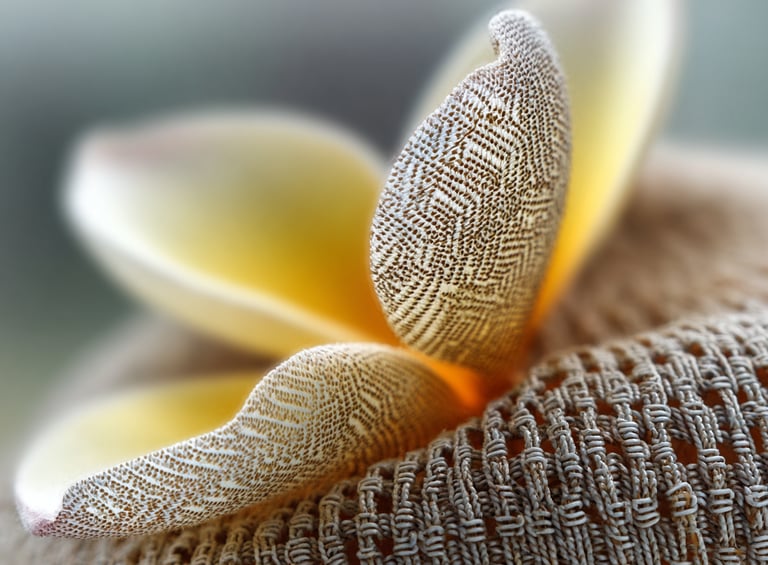
Weaving has never been ornament first. It has always been structured. Pattern comes later, if at all. Long before baskets entered concept stores or editorial spreads, they were technologies, used to hold food, transport goods, store grain, and endure seasons.
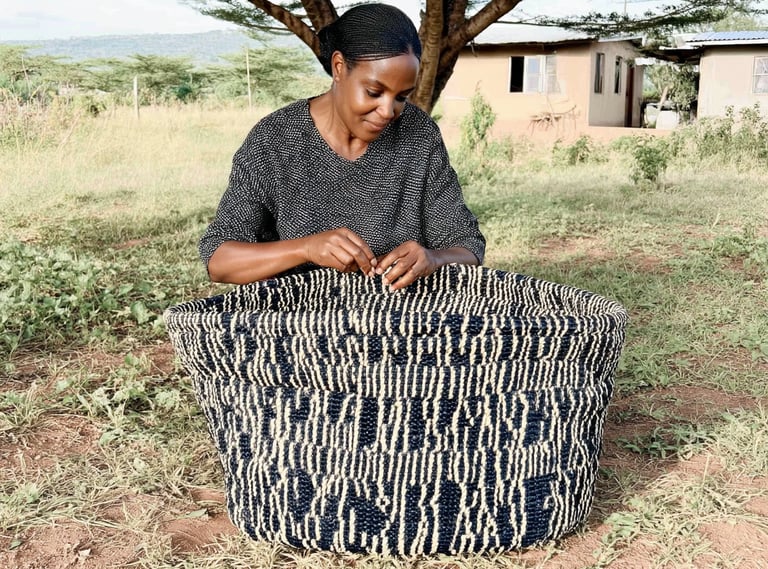
Visiting our makers in Kitui, a basket sits half-finished beside a doorway: sisal coiled, a stone weighting the base against the wind. The strands vibrate gently, wispy and fresh. It will be picked up again after lunch, after the children, after the rain.
A basket was not a lifestyle choice. It was a solution.
During and after my PhD, a familiar question followed me: academia, development, or design? As though these were mutually exclusive territories, neatly fenced. But research has a way of unpicking boundaries. My work on social innovation, gender, and marginalised labour revealed something quietly insistent: I did not need to choose. The most honest work lived in the overlap.
In Kenya, weaving occupies that overlap with ease. Sisal baskets sit at the centre of domestic economies, largely unnoticed. They carry grain, laundry, harvests, firewood, and children’s toys. They move between home and market, village and town, hand to hand. They are repaired rather than discarded, reused rather than replaced. They endure. Their longevity is not sentimental; it is practical.
And yet, when these same forms appear in global interiors or fashion, they are suddenly reclassified as design objects, heritage pieces, artisanal statements. Something that was always intelligent is finally allowed to be seen as such.
This is not a gap of skill or intelligence, but of legibility: between what sustains life and what is permitted to be called design.
This is where PAM YO! begins.
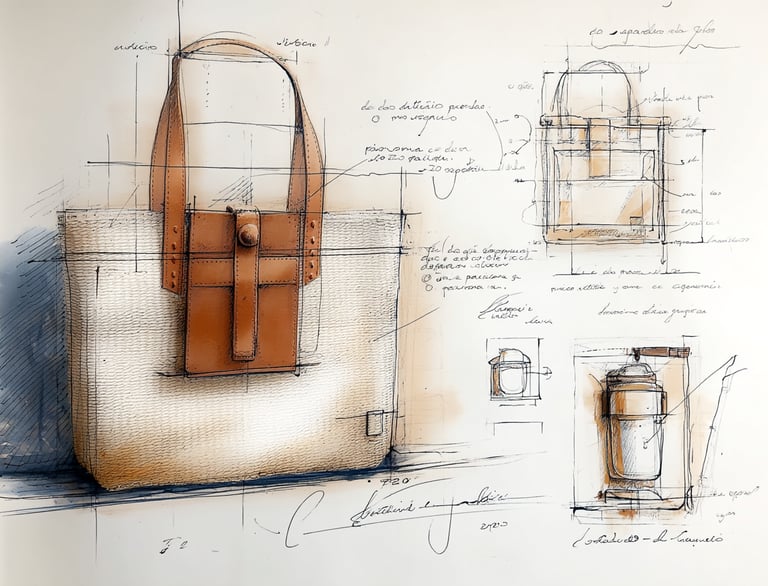
We start with baskets not because they are fashionable, but because they are foundational. A basket teaches proportion. Strength without excess. How systems hold, how weight is distributed, how tension is managed. Form emerges from function, not decoration. In this sense, a basket is a lesson in infrastructure.
PAM YO! does not intervene to elevate weaving. It intervenes to stop misreading it.
Weaving is often described as slow, usually as a caveat. But slowness here is not inefficiency; it is discipline. Sisal must be stripped, dried, twisted, and softened by hand. The body learns the fibre. The fibre learns the body. This is not delay. It is attunement.
This labour is predominantly carried out by women, who organise production around care, seasons, and community. Work is routinely labelled informal, yet governed by trust, rhythm, and collective accountability. These are not accidental systems. They are adaptive ones, refined over time. I acknowledge the systems and aim to improve them.
What this work asks is not to be modernised, but to be read correctly, as design, as engineering, as culture. To allow baskets to exist as contemporary objects without stripping them of origin or purpose.
Luxury, here, is not embellishment. It is clarity. Knowing when to add nothing. Letting the material speak. Letting the form hold. Letting the object last.
Weaving is not a trend because it does not move with seasons. It moves with people. It adapts. It survives. It remembers.
In an era organised around disposability, that may be its most radical quality of all.
Weaving remembers not because it looks backwards, but because it has never forgotten how to hold.
E — Eye
Salehe Bembury crocs collaboration
Fashion, Function, Texture, Permission
This week, I paused on the Salehe Bembury x Crocs collaboration, not because it is new, but because it is honest. I have a favourite swimming pair. Everyone knows how agh it is to put anything on after a swim. Crocs are my footwear solution.
Crocs have always been functional objects hiding in plain sight. Waterproof, durable, forgiving to the foot. They are worn by nurses, gardeners, cooks, and children. They were never trying to be elegant. They were trying to work.
Salehe Bembury does not correct this. He listens to it.
Rather than disguising the shoe’s utility, he amplifies its material logic—texture, contour, surface. The collaboration doesn’t elevate Crocs into fashion; it gives them permission to be read as design.
This is a familiar pattern. Objects created to endure—to carry bodies, weight, labour—are often dismissed until someone from the design world reframes them. Suddenly, what was always intelligent becomes visible.
There is a quiet echo here with weaving. With baskets. With women’s work. With forms that were never decorative, only later allowed to be admired. What we call radical exposure today often mirrors what was once practical, ceremonial, or joyful. Salehe Bembury understands this instinctively, designing that moves with the body rather than restrains it.
Good design does not add meaning.
It reveals the meaning that was already there.
Check this out https://www.tiktok.com/@tcrfff/video/7564784911488453918
A — Archive
Book: The Brain Fog Fix — Mike Dow, PhD
I’m reading this not as self-help, but as maintenance. Clarity is a resource. Like weaving, it depends on rhythm, rest, and respect for limits. One early takeaway: reduce sugar. Less noise, more signal.
V — Voice
Creating Long Distance
Long-distance work exposes every weakness in a system. It forces clarity, or collapse. Teaching, design, collaboration: all of it works better in presence. Until it doesn’t. This is the problem I’m learning to design for.
E — Echo
What do we lose, and unexpectedly gain, when creative work happens at a distance?
Until next Time,
Linda Odhiambo Hooper
@PlentyPowerHQ